Tag: #messagingmatters

  • Transitioning? Rely on Your Transformation Statement

    Transitioning? Rely on Your Transformation Statement

    This concise expression of who you are, what you stand for and whom you most want to serve can inform your flight plan in times of change.

    As changes come into your life (and they will, over and over!), your transformation statement can give you a solid foundation from which to respond.

    In this blog, let’s look at what a transformation statement is and how it can help you soar through all sorts of transitions.

    What Is a Transformation Statement?

    Also known as a 30-second commercial, positioning statement or “elevator pitch,” a transformation statement is a single sentence that encapsulates what you do best in the world, whom you most want to serve and the transformation you are uniquely poised to help them make.

    When we at Revealing Genius work with our clients on their executive personal brands, we ask them to tell us their signature brand stories—the stories that are their alone, that their competitors can’t tell. We listen closely and help them fill in the following formula:

    I <action word> <my beloved avatar> how to <do what they want to accomplish> so that they can <have the result/transformation>.

    Think about a story from your life that resonates with you. This is a story that you probably tell over and over, in lots of contexts. Most likely this story gets at the heart of what you do and what you stand for. 

    Reflect on that story as you fill in the blanks in the formula:

    <Action word> What was the key thing that you did in this story? What is the one action word that best describes your action? (For Revealing Genius, the word is “guide.”)

    <Beloved avatar> Who did you help in the story? What are the details about that person that make them so important to you? Consider the person’s age, gender, profession, faith or hobby. Get into the details. (For Revealing Genius, this is “healthcare leaders.”)

    <What they want to accomplish> What was the goal or objective of the person you helped? (Revealing Genius clients want to purposely identify and articulate their brand value.)

    <The result/transformation> What significant change did you facilitate in this story? Be sure to consider the emotional impact of what you did. (The transformation that Revealing Genius is uniquely poised to create for our clients is positioning them as recognized experts in their fields so they can rapidly achieve the next milestones in their careers.)

    Putting all those pieces together, here’s the Revealing Genius transformation statement:

    We <guide> <healthcare leaders> to <purposely identify and articulate their brand value> so they <become recognized experts and rapidly achieve the next milestones in their careers>. 

    What’s yours?

    Transformation Statements in Times of Transition

    Throughout our lives and careers, our who, what, where and hows will change, possibly many times.

    What we do for a living could evolve as our careers progress and we develop as individuals; “where” we dwell could shift, whether the move is planned or unplanned; when comes and goes, i.e. when I get my Master’s degree or when the kids move out; the “hows” we operate with in the world also constantly change, i.e. doing the things that a rising star does versus leading as a CEO.

    But our “why” is constant, our True North guide, the thing that helps us navigate gracefully always.

    It does take a bit of work to clarify, believe in and learn to articulate our core purpose. But doing so is totally worth it. 

    As part of the celebration of July 4, 2024, Revealing Genius hosted a special Transformation Thursday workshop for graduates of our Brand Leadership Summit featuring Jean Paul “JP” Dube. I had the pleasure of attending JP’s retirement ceremony in May 2024 honoring his service as a captain in the United States Navy.

    Even though JP recently completed his tour of duty, he still has “a lot of gas left in the tank” as he re-enters civilian life. He sought (and got) feedback on his transformation statement. The workshop participants and I helped him craft a powerful one that will propel him forward in his next chapter.

    JP’s transformation statement before the workshop:

    I enable small to medium size businesses with security and risk management challenges to develop effective and cost saving security and risk management programs so their business can remain competitive in their field.

    After the workshop:

    I equip healthcare leaders to examine risks to their organization so they can develop hack-free countermeasures that ensure employees are safe and patients receive uninterrupted care.

    The Benefits of Being On-Purpose

    Companies have known the benefits of being on-purpose for a long time. Gartner says on-purpose brands outperform their competitors by 120%. Individuals can take a page from this playbook and thrive.

    Imagine the possibilities for yourself if you had a transformation statement and other executive personal brand collateral in hand. When you clarify your why, affirm it until you believe in it with conviction and learn to tell others about it (that’s our time-proven Excavate-Tell-Affirm™ process in action!), you’ll be making a positive impact and feeling fulfilled, no matter what, where you or how you are in the world! 

    Are you ready to take the next step? We’d be honored to assist you. Learn more through our free 10-minute webinar, Brand Leadership Summit or online course. We’re honored to work with boards and leadership teams as well as individual leaders on your transformation statement and your brand manifesto.

    Mary E. Maloney

    Mary E. Maloney, FACHE

    An executive advisor, educator, speaker, author and producer, Mary E. Maloney is the founder of Revealing Genius and the expert that accomplished leaders trust for positioning, messaging and brand strategy for themselves, their teams and their organizations. A former CEO and CMO, Maloney guides C-suite leaders, founders, physicians and board directors to powerfully and strategically message their expertise and “why” so they lead with conviction and achieve their most coveted goals.

  • The Aim of Your Transformation Statement? Flight!

    The Aim of Your Transformation Statement? Flight!

    This succinct expression of your executive personal brand will help you better understand who you most want to serve so your career or business can soar.

    Why does a caterpillar transform into a butterfly? So it can fly!

    So too with transformation statements … by creating and strategically deploying this key brand message, you’ll be able to effectively articulate to anyone, in any situation, the unique transformation only you can help them achieve. And then you and the people you help will both take wing!

    In this blog, I’ll talk about the time-proven Excavate-Tell-Affirm™ process from Revealing Genius and how it can help you develop your transformation statement. Then I’ll dive into the formula for a well-crafted transformation statement that can help you clarify who you most want to serve (your beloved avatar), so you can do The Great Work of Your Life.

    The Cocoon (Process) for Creating Your Transformation Statement 

    We’ve previously posted on the Revealing Genius blog about our process for developing a truly effective transformation statement, also known as an “elevator pitch,” a 30-second commercial or positioning sentence.

    During the excavate step of the time-proven Excavate-Tell-Affirm™ process, Revealing Genius listens actively to leaders as they tell their brand stories. Telling unique stories typically leads to an all-but-perfect transformation statement as this simple but effective formula gets filled in: 

    I <action word> <my beloved avatar> how to <do what they want to accomplish>
    so that they can <have the result/transformation>.

    As an example, here’s a transformation statement for Revealing Genius: 

    We <guide> <healthcare leaders> to <purposely identify and articulate their brand value>
    so they <become recognized experts and rapidly achieve the next milestones in their careers>. 

    Notice that while the formula is designed to express what you do, it’s really all about the people you want to serve, your “beloved avatar,” and the transformation you are best in the world at helping them achieve.

    This article from ellispond.com says it well: “It’s not just about understanding who they are, it’s about understanding who they want to become.

    “They have a problem, and you have the solution,” the article continues. “But nothing will sell that solution if you don’t understand the transformation that needs to take place within them.”

    Here at Revealing Genius, we ask clients, participants in our Brand Leadership Summit (the next one will take place Sept. 5-13) and people taking our on-demand online course to reflect on their beloved avatars. What is their day like? What are they thinking? What are they feeling? What are they struggling with? Why are they turning to you for help? 

    It’s important to get as much detail in your mind’s eye about your beloved avatar and include that detail in your transformation statement. Does this mean you can only serve people who meet all your criteria for a beloved avatar? Of course not. In all, your clarity about the transformation you were born to support will help you better articulate, with conviction, your unique genius.

    Your Transformation Statement Helps Your Career or Business ‘Take Off’

    I can honestly say that people come alive when they excavate their personal brands and learn to tell others about them through messaging tools like the transformation statement. When they also affirm their brands so they can feel them in their bones, the power of that conviction spills over into being on-brand every day.

    Gartner says on-purpose brands outperform their competitors by 120%. Individuals can take a page from this playbook and thrive.

    I’ve seen it happen many times.

    Here’s a shining example from my blog: How Kate Found Her Dream Job.

    I’ve also seen people who go through our Excavate-Tell-Affirm™ process get the promotion they seek, be selected for a coveted board seat, start a new business, grow an existing organization, do an outstanding update to their LinkedIn profile or CV, make a top-notch all-staff presentation … and so much more.

    Ready to excavate your genius and, in turn, transform the world? We’d love to help you, your career and your organization soar—in service to your beloved avatar.
    Learn more about executive personal branding, including transformation statement development, through our free 10-minute webinar, Brand Leadership Summit or online course. We’re honored to work with boards and leadership teams as well as individual leaders.

    Mary E. Maloney

    Mary E. Maloney, FACHE

    An executive advisor, educator, speaker, author and producer, Mary E. Maloney is the founder of Revealing Genius and the expert that accomplished leaders trust for positioning, messaging and brand strategy for themselves, their teams and their organizations. A former CEO and CMO, Maloney guides C-suite leaders, founders, physicians and board directors to powerfully and strategically message their expertise and “why” so they lead with conviction and achieve their most coveted goals.

  • Why You Need to Align Your Board (and C-Suite) With a Brand Declaration

    Why You Need to Align Your Board (and C-Suite) With a Brand Declaration

    Uniting your top leaders is fundamental to your organization’s success.

    What’s the one thing you want your audience to know about your organization? The one thing that, if you articulated it well, would align your board and thereby put you fully on track to deliver on your mission and vision? The answer is at the heart of your brand declaration, a statement of the aims of your company or non-profit.

    Take the case of The Atlas Enterprise, which publishes the resource lovingly known as “the Bible of neurosurgery.”

    When The Atlas Enterprise worked with Revealing Genius and strategy consultancy Clarke & Esposito to build its brand declaration, it created unprecedented alignment among its leadership team members—the board directors and its founder and public voice, Aaron Cohen-Gadol, M.D.

    Before creating the brand declaration, the non-profit’s leaders were struggling with how to talk meaningfully and compellingly about the organization’s portfolio of products together, then as stand-alones. Since developing the brand declaration, the team has been able to describe the non-profit’s offerings so their complexity is heard and understood. 

    In addition, the brand declaration development process helped Dr. Cohen recognize and acknowledge that his personal brand was just as important to organizational success as the overarching brand. He wrote a brand declaration for himself, too! (Read the case study about this initiative.)

    Board and leadership alignment are clearly key to organizational success. Let’s dive deeper into the ways it can help with high-level strategic work and day-to-day governance, key obstacles to achieving board alignment, and strategies for overcoming those obstacles, including the brand declaration.

    The Board Alignment Imperative

    At a high level, board alignment is fundamental to overall organizational health and success because it boosts decision-making, organizational culture, stakeholder confidence and the ability to adapt to changing circumstances. 

    The benefits of board alignment in day-to-day governance also are many. A board that’s aligned: 

    • Ensures the organization’s mission and strategic pillars are promulgated. When everyone on the board is on the same page, working collaboratively towards common objectives becomes easier, increasing the likelihood of success in achieving the organization’s mission.
    • Streamlines consensus in decision-making and actions. When board members share values, vision and goals, gaining consensus on critical decisions becomes easier. Alignment also enhances the effectiveness of the board’s actions.
    • Helps raise the floor on organizational culture. A cohesive board with shared values and a unified vision can set an example for the rest of the organization, demonstrating a culture of teamwork, trust and collaboration.
    • Inspires stakeholder confidence. When stakeholders see a united front, they are more likely to trust the organization’s leadership and support its initiatives.
    • Can better adapt the strategic plan to changing circumstances. Alignment is crucial during the strategic planning process. A unified board can more effectively develop and implement strategic plans that reflect its collective wisdom and vision. This enhances the organization’s ability to adapt to changing circumstances and achieve long-term success.
    • Provides common ground for conflict resolution. In any organization, conflicts can arise. Shared values and goals provide a foundation for finding common ground and working toward mutually beneficial solutions.
    • Increases board member commitment, engagement and retention. Members are more likely to be engaged and committed when they feel the board aligns with their interests and values. This, in turn, fosters a stable and supportive community. 
    • Increases the effectiveness and efficiency of governance processes. For example, when board members are aligned, onboarding and offboarding board members become seamless.

    10 Obstacles to Board Alignment

    An organization benefits when its board and leadership team are aligned, but getting there isn’t always easy. Here are some common obstacles that can get in the way of uniting your top leadership.

    1. Diverse backgrounds and perspectives. Board members often come from diverse professional backgrounds, disciplines and experiences. Balancing these diverse perspectives and aligning them toward a common vision can be challenging, especially if differences in values or priorities exist.
    2. Competing interests. Board members may have different interests or priorities based on their roles, affiliations or professional agendas. Conflicting priorities can make it difficult to achieve alignment on overarching organizational goals.
    3. Limited communication. Inadequate communication or information-sharing among board members can hinder alignment. If members aren’t well-informed about the organization’s mission, goals or ongoing activities, it can become difficult for them to align their efforts.
    4. Lack of trust. A lack of trust among board members can lead to skepticism, resistance to change and difficulties in reaching consensus on important decisions.
    5. Turnover and transitions. Board turnover or changes in officers can disrupt alignment efforts. New members or board chairs may bring different perspectives or priorities, and it takes time for them to integrate into the existing culture and align them with the organization’s objectives.
    6. Resource constraints. Limited financial or human resources can lead to competing demands and priorities. Board members may struggle to align with one another when faced with resource constraints or competing for the same limited resources.
    7. External pressures. Changes in regulations, economic conditions or shifts in the academic and professional landscape can create challenges for board alignment. Adapting to external pressures while maintaining alignment requires excellent strategic planning and effective communication.
    8. Lack of strategic planning. Without a clear and well-defined strategic plan, board members may lack a roadmap for alignment. A lack of strategic direction can result in disparate efforts and conflicting actions among members.
    9. Cultural differences. In organizations with international or diverse memberships, cultural differences can contribute to challenges in achieving alignment. Different cultural perspectives and expectations may need to be navigated and harmonized.
    10. Communication styles. Differences in communication styles among board members can lead to misunderstandings and misinterpretations, making it difficult to establish a shared understanding and alignment.

    Building a Board Declaration

    Overcoming the challenges above requires thoughtful and proactive efforts from board leaders, including employing effective communication strategies, fostering a culture of trust and collaboration, and investing in team-building activities. Regular assessments of board dynamics and a commitment to reaching a shared vision also are essential.

    At Revealing Genius, we recommend a brand declaration to support board and leadership alignment and effectiveness. Developing a declaration based on our time-proven Excavate–Tell–Affirm™ process helps excavate your company’s purpose, what it stands for and whom it most wants to serve. Once you’ve excavated your brand, you can affirm it until all your leaders feel it with conviction and more effectively tell all your stakeholders about it.

    Considering a brand declaration for your organization or yourself? We’re honored to work with boards and leadership teams and individual leaders. You can also learn more via our free 10-minute webinar, Brand Leadership Summit or online course.

    Mary E. Maloney

    Mary E. Maloney, FACHE

    An executive advisor, educator, speaker, author and producer, Mary E. Maloney is the founder of Revealing Genius and the expert that accomplished leaders trust for positioning, messaging and brand strategy for themselves, their teams and their organizations. A former CEO and CMO, Maloney guides C-suite leaders, founders, physicians and board directors to powerfully and strategically message their expertise and “why” so they lead with conviction and achieve their most coveted goals.

  • Executive Personal Branding Builds Trust With Patients

    Executive Personal Branding Builds Trust With Patients

    Healthcare leaders, departments and organizations with on-purpose brands elevate patient care and propel themselves forward.

    This blog was originally published on swaay.health.

    Stacey Parkin is the chief patient experience officer of a large health system in Washington state. For her, improving the patient experience is personal—and a key element of her executive personal brand.

    “Having a child with a congenital heart defect and a mother with MS, I have navigated the healthcare system for years and wanted to make it better from the inside out,” she says in an article from Healthcare Innovation. “I am passionate about my work and making the experience more seamless and personal.”

    Having such clarity about their purpose and where it comes from helps healthcare marketers like Stacey build trust and credibility with patients.

    A healthcare marketer’s executive personal brand is in turn very important to medical facilities, as patients develop their impressions about a facility based on their interactions with the professionals they meet there.

    Executive personal branding—for individual marketers, whole departments and even boards and entire organizations—is a key tool for clarifying purpose, deepening conviction about that purpose and finding the best ways to express it. Done right, personal branding helps leaders, their organizations and ultimately, their patients.

    So, what exactly is executive personal branding? And how can you, your team and your organization use it to create a sustainable positive impact on individual, team and organizational performance that will lead to a top level of patient care?

    What Is Executive Personal Branding?

    Executive personal branding is about excavating what you stand for, who you would most like to serve and the transformation only you can create for them.

    It’s also about learning how to do a good job when you tell everyone you meet, in every setting, about your brand. Going through an executive branding process should help you ably and confidently answer the age-old business question, “So, what do you do?” It can also help you build an effective LinkedIn profile, prepare an on-brand all-staff presentation, write a CV that will help you get an interview and then give an amazing interview.

    Executive personal branding is also about affirming your brand. After you go through the process, you will be able to feel your brand in your bones and share it with conviction.

    The Power of Taking Personal Branding Past the Individual Level

    I have worked with many individual healthcare leaders to refine their executive personal brands. Knowing what you stand for, who you most want to serve and how to express those two things is powerful in helping individuals take their next right steps.

    And executive personal branding can be even more powerful and transformational when groups of leaders look at it together.

    In addition to working with individual leaders as a consultant, I’ve facilitated the development of marketing department brand manifestos as a chief marketing officer, ensuring that everyone in the department aligned on why the group existed and exactly how it was meant to serve the organization.

    As a CEO, I’ve worked with C-suite leadership teams on the brand message for the high-traffic “About” page of the organization’s website. In the CEO role, I’ve also worked with board members, enabling them to align with a brand manifesto for their organization, a document that goes beyond vision, mission and values to emotionally describe why and who their organization exists to serve.

    It is exciting for everyone involved when branding goes throughout the organization. The patient experience benefits when staff engagement goes up as the process progresses, and each team member becomes more effective in building trust and credibility with everyone they serve.

    Try This On: An Executive Personal Branding Exercise

    In my executive branding work with leaders at all levels, I present numerous small exercises as part of Excavate-Tell-Affirm™ process to help them clearly articulate their foundational purpose. Here’s a three-minute example you can try right now:

    Take out a piece of paper and make two columns on it, one with the header, “More of this, please,” the other with the header, “Less of this, please.” Spend two minutes completing your table. Think about all aspects of your life as you compile your answers: spirituality, health, style, relationships (family, friends, community), work, finances, recreation, social and learning. Write down what comes top of mind.

    Now, look at your list. What stands out to you? When you think of your executive personal branding, what gives you energy when you do it? What would you like to say yes to?

    There are many more strategies and tools for developing an executive personal brand for yourself, your department, your C-suite, your board and your whole organization. Learn more by taking our self-paced online course, and let us know how we can help.

    Mary E. Maloney

    Mary E. Maloney, FACHE

    An executive advisor, educator, speaker, author and producer, Mary E. Maloney is the founder of Revealing Genius and the expert that accomplished leaders trust for positioning, messaging and brand strategy for themselves, their teams and their organizations. A former CEO and CMO, Maloney guides C-suite leaders, founders, physicians and board directors to powerfully and strategically message their expertise and “why” so they lead with conviction and achieve their most coveted goals.

  • Rise Above the Noise: 6 Characteristics of On-Brand Key Messages

    Rise Above the Noise: 6 Characteristics of On-Brand Key Messages

    These bite-sized statements must articulate what you do, why you do it and the unique value you bring to the people you most want to serve.

    The healthcare space, like most industries, is busy—“noisy,” even—with lots of well-meaning people trying to make a positive difference in the world. A well-positioned executive personal brand that’s supported by exactly the right key messages can help you rise above the noise.

    Key messages are bits of information that articulate what you do, how you do it and what makes you different. You can put key messages to work for you by including them in any communication—from a team presentation to your application for your dream job or board seat to your LinkedIn profile.

    Let’s talk more about six important characteristics of outstanding key brand messages—and how you can use your messages to rise above the noise and stand out for the unique contributions that only you can make in the world.

    6 Characteristics of Effective Key Messages for Executive Personal Brands

    Most articles you read online about key brand messages (like this one from Onyx Health and this one from Map & Fire) say key messages need to be short, specific, digestible/repeatable, strategic and memorable. I’d add that the best key messages are also emotional. Let’s look at each of these in turn.

    1. Short. Doing executive personal branding using Revealing Genius’ time-proven Excavate–Tell–Affirm™ process will help you use fewer words (and more confident ones) to state your key brand messages. You’ll be pithy and on point, but concise. (Check out this related blog.)
    2. Specific. To help distinguish your brand from others, it’s helpful to get into the details. That way, you can better stand out from the sea of sameness. Try starting your key message with “We were the first to…” or “What makes me stand out is …”
    3. Digestible/repeatable. Being succinct and specific will help the people you most want to serve to understand who you are and what you do. Having a successful executive personal brand means you know how to effectively tell others about it in any situation—whether that’s during the two minutes you’ll get when they look at your CV or application or LinkedIn profile or the 30 seconds you’ll have in the proverbial elevator. And of course, when people have been able to comprehend your brand message, they’ll be better able to share it with others.
    4. Strategic. Your key message will be strategic when it’s positioned to help you achieve one or more big goals. A key message of standing for “inspiring hope” might be just the thing for the brand of the leader of a company striving to find medical cures.
    5. Memorable. Your key message will be more memorable if it taps into a hook or idea that separates you from others. The thing about an elephant in a pink tutu is that everyone remembers it!
    6. Emotional. Once your key message is short, specific, digestible, specific, strategic and memorable, it will already be good. If you can also make it emotional—so that it ties to the transformation only you can bring to the people you serve—it will be a home run with your target audience. Think about your answer to the question, “What am I best at in the world?”

    The excavate step of the Excavate–Tell–Affirm™ process tees up being able to leverage key messages to tell your most important audiences—whether that’s your team in a staff meeting, a hiring executive or the chair of the board—how you stand out. Ready to try this out?

    Get instant access to the free Revealing Genius 10-minute webinar, sign up for our Excavate-Tell-Affirm™ Brand Leadership Summit or take our online course. We would be honored to work with you 1:1 or to help you develop your brand manifesto.

    Mary E. Maloney

    Mary E. Maloney, FACHE

    An executive advisor, educator, speaker, author and producer, Mary E. Maloney is the founder of Revealing Genius and the expert that accomplished leaders trust for positioning, messaging and brand strategy for themselves, their teams and their organizations. A former CEO and CMO, Maloney guides C-suite leaders, founders, physicians and board directors to powerfully and strategically message their expertise and “why” so they lead with conviction and achieve their most coveted goals.

  • From Brand Declaration to Magazine (or Other Media) Placement

    From Brand Declaration to Magazine (or Other Media) Placement

    Executive personal branding supports a positive presence in your channels of choice.

    A female co-founder CEO leverages her company brand declaration (which parallels her personal executive brand) each time she publishes her “Living Well With Laura Henshaw” column in Vogue magazine.

    This excerpt introducing Henshaw’s Jan. 14 “Controversial opinion” column in Vogue also underscores what she and her Australian company Kic stand for—their “why.”

    A recent study has found that 34% of New Year resolutions are associated with weight loss. It’s embedded in us, through toxic diet culture, that with a new year, we should strive to weigh less, drop a size, restrict our diet, “bounce-back.” The list goes on.

    Aesthetic-based resolutions can be so harmful. That’s why at Kic, we’ll never condone before and after photos. Because essentially, we’re telling ourselves that our “before”—as we are, right in this moment—is not enough. But this is your reminder that your weight does not define your worth. You are enough, just as you are.

    Notably, this is the message Henshaw communicates in every media interaction because she understands a Revealing Genius tenet: “The hallmark of every iconic brand is consistency.”

    In keeping with this, Henshaw’s co-founder, Steph Claire Smith, recently leveraged Kic’s brand declaration and her personal executive brand in her Jan. 12 Marie Claire article, “Steph Claire Smith’s Tips to Stick to Your Resolutions on ‘World Quitter’s Day.’”

    Smith expresses the big idea behind the brand very concisely in her bio on that piece:

    Steph is the co-founder of Australian health & wellness app Kic. It was her personal experience with toxic wellness, perpetuated by social media and the modelling industry, that sparked a fire in her belly to make a difference, rewrite the diet “rule book”… and help others build a healthy and more sustainable relationship with food & exercise.

    Going through the Excavate–Tell–Affirm™ process from Revealing Genius helped these two leaders clarify their personal and company brands, learn how to tell their unique brand stories and affirm their brands until they felt them in their bones.

    In addition to supporting them in their media endeavors, the pair’s branding work also helped them rebuild the messaging for a Series A pitch deck to secure funding that will enable the two female founders to drive a global health and wellness movement through Kic.

    During the excavate step of the process, the two discovered their two-word purpose statement: lighting the way. They continued to clarify their brand and tell it as they wrote this transformation statement: We inspire people to take care of themselves, so they feel confident in who they are and believe they have everything they need to be enough. And when you read what they write in the media, you can feel their conviction about what they are doing—which comes from the affirmations part of the process.

    You, too, can leverage personal executive branding and your resulting brand declaration to support solid media appearances—and confidently go after funding for your start-up as well.

    What Is This Foundational Excavate–Tell–Affirm™ Process?

    The Excavate–Tell–Affirm™ process that Henshaw and Smith used is a bespoke methodology designed to be swift, thorough and energizing. It is built on many small and fun experiences and exercises uniquely positioned to help leaders excavate what they stand for and who they most want to serve; learn strategies for effectively telling others about their brand and exercises; and finally affirm their brand so completely that they can feel it in their bones. The process allows leaders like Henshaw, Smith and you! to choose whether to approach personal branding a little at a time or all at once.

    Gaining consumer media visibility and obtaining critical funding are not the only possible positives that can stem from going through the Excavate–Tell–Affirm™ process from Revealing Genius. The methodology has also been used successfully by many leaders to get their dream job, obtain a board seat, become incredibly effective at public speaking, change careers (and create their dream job in the process), navigate uncertainty, write a winning business plan, develop a one-sheet professional biography or elevator pitch, make their LinkedIn page (and their social media presence overall) more purpose- and power-ful, and lead a highly engaged team. I could go on and on, but you get the idea.

    Gain more insight into doing executive personal branding and developing your brand declaration using this time-proven approach! Get instant access to the free Revealing Genius 10-minute webinar, sign up for our Excavate-Tell-Affirm™ Brand Leadership Summit or take our online course. We would be honored to work with you 1:1.

    Mary E. Maloney

    Mary E. Maloney, FACHE

    An executive advisor, educator, speaker, author and producer, Mary E. Maloney is the founder of Revealing Genius and the expert that accomplished leaders trust for positioning, messaging and brand strategy for themselves, their teams and their organizations. A former CEO and CMO, Maloney guides C-suite leaders, founders, physicians and board directors to powerfully and strategically message their expertise and “why” so they lead with conviction and achieve their most coveted goals.

  • Can AI Tell Your Executive Personal Brand Story Better Than You Can?

    Can AI Tell Your Executive Personal Brand Story Better Than You Can?

    It can probably tell it faster, but better is a different thing altogether. Still, there’s value in knowing and leveraging these powerful tools.

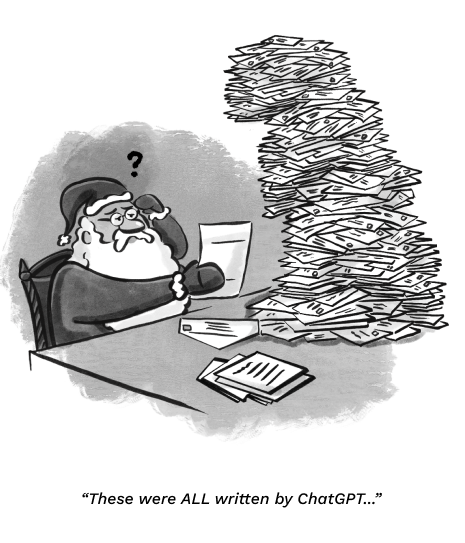
    With the explosion of ChatGPT and other artificial intelligence tools over the last year, it would be no wonder if Santa got a lot of letters written by AI this past holiday, as suggested in this clever cartoon by Ontraport, the marketing automation tool used by Revealing Genius. (Big thanks to Nicole, graphic designer at Ontraport, who created it for Ontraport comics.) The question is, how good is artificial intelligence, really, at writing a kid’s letter to Santa—or in helping a healthcare leader with executive personal branding?

    santa letters pil

    The short answer is that ChatGPT is very good at storytelling, and you might even call it prolific in how readily it can create a great deal of content and messaging. Generative AI is expected to get even better as it continues to learn over time.

    But there are three significant “but’s” we need to discuss.

    The first but, and it’s is a pretty big one, is that these large language model platforms make things up. Some sources suggest that they will provide misinformation even when they know they shouldn’t!

    The second but, and this is an even bigger one, is that ChatGPT, Claude.ai and their counterparts are not human—and never will be. So, they’ll continue to be machine-like in how they approach the world, no matter how good they get. Maybe machine activity is not what you want at the base of your executive personal brand.

    Thirdly, they’re not you—and never will be.

    This clever meme, whose original author we couldn’t easily contact for permission to reprint it fully here, illustrates the vast value of humanity.

    In the first frame, a cat labeled “artist” is fishing in a puddle with a bait bucket next to him. In the second frame, a second cat is approaching. In the third frame, the second cat is labeled “AI.” It is sitting near the artist cat, fishing out of the artist cat’s bait bucket.

    In other words, the artist can draw from a much bigger pool than AI can.

    Taking all of this into consideration, Revealing Genius currently considers generative AI to be a useful tool in creating the messaging that you’ll need for your executive personal brand once you develop it.

    The balance of this blog will describe the time-proven Excavate–Tell–Affirm™ process that Revealing Genius uses to help healthcare leaders develop their executive personal brands, then present ideas about how AI might be a useful tool in creating some (but not yet all!) of the messaging and collateral you’ll need to take your brand into the world.

    Excavate–Tell–Affirm™ Process for Executive Personal Branding

    The Excavate–Tell–Affirm™ process is a bespoke, time-proven methodology that helps healthcare leaders like you achieve their goals. Designed to be swift, thorough and energizing, the process has been used by visionary thought leaders including global C-level executives, physicians, public servants, military leaders, Ph.D.s, healthcare startup company leaders and consultants. Many say it was the catalyst to transforming their respective brands.

    What does it mean for your life and career to develop your brand? It means knowing your purpose. It means having conviction about what you really stand for. It means getting clarity about your next right step.

    Having an executive personal brand that really resonates for you supports many possible real-life efforts. Tick all the items below that you’re interested in doing. Personal branding can and has supported all of them:

    ___Getting a dream job

    ___Getting a board seat

    ___Being incredibly effective at public speaking

    ___Changing careers (and getting a dream job)
    ___Revising a curriculum vitae or resume

    ___Developing a one-sheet professional biography or elevator pitch

    ___Pursuing a career passion

    ___Pursuing a retirement passion

    ___Updating a LinkedIn page (and your social media presence overall) to make it purpose- and power-ful

    ___Revising a resume to make it purpose- and power-ful

    ___Putting up an effective website

    ___Putting up a fantastic virtual studio in Zoom

    ___Writing a winning business plan

    ___Acquiring series A or series B venture capital funding

    ___Creating a compelling video or podcast

    ___Leading a new team

    What are some things you’re considering doing next in your life? It’s highly likely that excavating your personal brand and developing messaging to better communicate it can move you toward ____________!

    Now, for a moment, let’s assume you’ve excavated your brand, formulated ideas about how you’ll tell it and affirmed it so you can feel it in your bones. How might generative AI help you take this cultivated brand out into the world?

    Using AI to Create Executive Personal Brand Materials and Messaging

    Generative AI technology like ChatGPT, Claude.ai and others is fluent and prolific in its use of language. Give it a few seconds and the right prompt, and it can summarize the transcript of an hour-long presentation. Give it another few seconds and another good prompt, and it can take that summary and create a 750-word article, then a related post for X or LinkedIn. When you’re ready to put your executive personal brand to work for you, AI is definitely a tool to leverage for its content-creating abilities.

    “The fusion of AI and personal branding is most evident in content creation,” according to this article on LinkedIn. “AI tools can generate high-quality, engaging content from blog posts to social media updates. With AI’s assistance, individuals can maintain a consistent online presence, freeing up time to focus on more strategic aspects of their brand.”

    According to Forbes, AI is even transforming the way professionals get headshots. It can be used to help generate and edit video, craft compelling narratives, optimize social media engagement and create websites.

    Another article from Forbes asserts, “with the right use of AI tools and a focus on authenticity and sincere connections, you can establish a strong personal brand that unlocks new doors, cultivates meaningful relationships and positions you as a leader in your industry.”

    Remember, you’ll need to keep a close eye on the technology because it sometimes creates fallacies, but there’s no doubt that it’s powerful.

    The second Forbes article offers these suggestions for useful AI tools for creating content for your brand:

    • ActiveCampaign, Constant Contact, Emma, Mailchimp, MailerLite: Email campaign management tools
    • Buffer: A social media management tool that helps you schedule posts and track engagement across multiple platforms
    • ElevenLabs: A natural-sounding speech synthesis and text-to-speech software using AI technology
    • Grammarly: A grammar and writing assistant that can help you ensure your content is error-free and polished
    • HubSpot,Pipedrive, Salesforce: Customer relationship management tools for building workflows and managing customers and leads
    • Ortto: An AI workflow assistant that generates marketing campaigns and content ideas for blogs, ads, emails and social media posts
    • Make, Zapier: Automation tools that connect various apps and allow the creation of workflows to automate repetitive tasks

    Solidify Your Brand First; Leverage AI Later

    Remember, before you jump into learning AI tools for brand content creation, create a solid executive personal brand. There are several easy ways to learn more about how the Excavate–Tell–Affirm™ process from Revealing Genius helps leaders like you with their branding efforts.

    For starters, read these three short blogs—and peruse our full blog. It’s free!

    1. Excavate Your Personal Brand: Three Keys to Unlocking Your Professional Brand
    2. Tell Your Personal Brand: Can You Say What You Stand for in Just a Few Words? (Tony Dungy can.)
    3. Affirm Your Personal Brand: Your Professional Brand Anchored by Assessments and Affirmations

    You can also learn more—and get started on developing your executive personal brand—by getting instant access to our free 10-minute webinar, signing up for our Excavate-Tell-Affirm™ Brand Leadership Summit or taking our online course. We would be honored to work with you 1:1.

    Mary E. Maloney

    Mary E. Maloney, FACHE

    An executive advisor, educator, speaker, author and producer, Mary E. Maloney is the founder of Revealing Genius and the expert that accomplished leaders trust for positioning, messaging and brand strategy for themselves, their teams and their organizations. A former CEO and CMO, Maloney guides C-suite leaders, founders, physicians and board directors to powerfully and strategically message their expertise and “why” so they lead with conviction and achieve their most coveted goals.

  • Will We Position and Message Our Brands On Purpose This Year?  

    Will We Position and Message Our Brands On Purpose This Year?  

    #messaging matters.

    One of the fundamentals of brand leadership that we teach in our live, facilitated Summit and our self-paced online course is to get clear on our purpose and build our compelling brand narrative around it.

    Therefore, this issue is chock-full of tools to direct our attention to being on purpose:

    #BrandOnPurpose

    Being a steward of our executive personal brands is no longer a nice-to-have, it’s a must-have strategy for ourselves, our teams and our organizations.

    That’s our wish for you, to pursue what rings your bells and message it in an authentic way so that it resonates with your “beloved avatar” (target audience) and brings you the impact and fulfillment you deserve.

    #RiseAbovetheNoise

    try this on

    Your “what” is easier for your audience to understand when you know your “why.” 

    Do you feel stuck, not sure what to do next? Feeling just a little passionless or purposeless or totally overwhelmed? Maybe experienced a recent loss in employment and/or direction and recovery has been slower than normal?  How about knowing for sure that you aren’t in the right place, but struggling to articulate what “the right place” looks like?

    Then a Brand Declaration is for you. This is a bespoke process where you will join an elite group of people who have committed the time and energy to “give words” to their true north and calling. Arguably one of the most important exercises you will engage in for your career. A vital component of leadership and personal development, it will ground you in your core values and enable you to say yes to areas where you have quantifiable impact and say no respectfully to things that don’t serve you anymore. Even if “what” you do changes throughout time, you will always be guided by your “why.” You will leave with a succinct one-pager that captures: 

    • Your purpose (two words) 
    • Your “why” statement (one sentence)
    • Your hows (up to nine)
    Recent feedback on the Brand Declaration: “Appreciate this more than you can imagine. | I am excited for the first time in months about my future. | It is as if you awaken people from their slumber. | Today’s brand declaration went places that completely surprised me and “my why” is exactly my why, and has been for decades and I did not consciously know it. | Thank you so much for putting fuel into my tank.”
    Mary E. Maloney

    Mary E. Maloney, FACHE

    An executive advisor, educator, speaker, author and producer, Mary E. Maloney is the founder of Revealing Genius and the expert that accomplished leaders trust for positioning, messaging and brand strategy for themselves, their teams and their organizations. A former CEO and CMO, Maloney guides C-suite leaders, founders, physicians and board directors to powerfully and strategically message their expertise and “why” so they lead with conviction and achieve their most coveted goals.